Iqtisodiyot
Central Asian Industrial Cooperation: Opportunities and Structural Changes
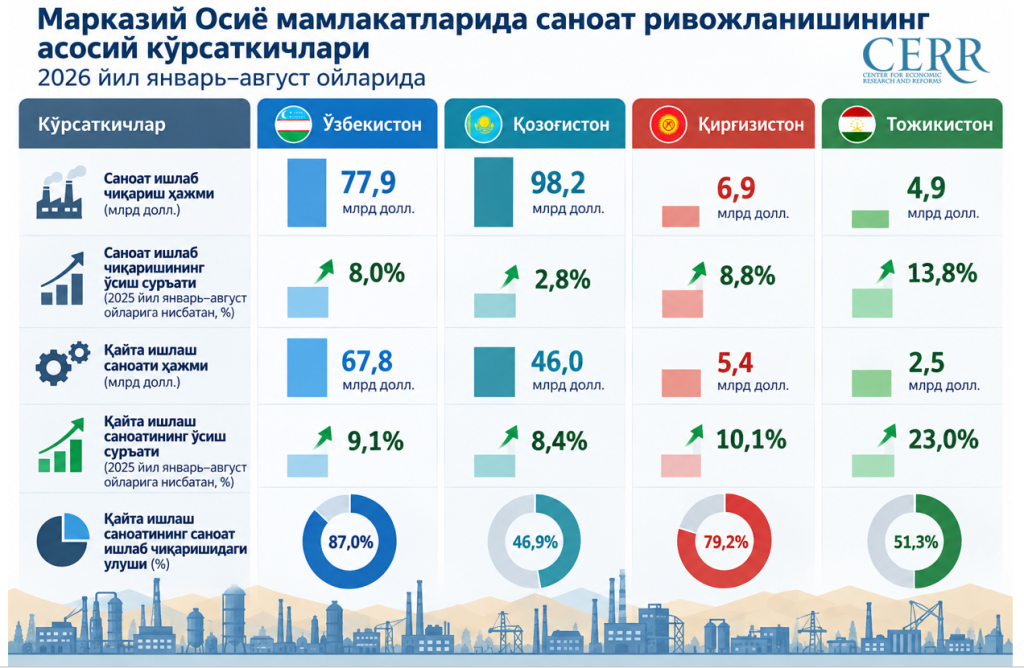
In January-August 2026, positive growth rates of industrial production were maintained in four Central Asian countries. The highest growth was recorded in Tajikistan at 13.8 percent, followed by Kyrgyzstan at 8.8 percent, Uzbekistan at 8 percent, and Kazakhstan at 2.8 percent.
The main trends in industrial development varied across countries. Specifically, in Kazakhstan, the volume of industrial production reached $98.2 billion in value terms. However, growth rates slowed down compared to previous periods, with the mining industry acting as the main limiting factor. Despite a decrease in oil and gas production, the manufacturing industry demonstrated growth.
In Kyrgyzstan, the growth rate of industrial production slowed to 8.8 percent, with production volume reaching $6.9 billion. The manufacturing industry grew, increasing its share in total industrial production. High growth rates were maintained in the chemical industry, automotive manufacturing, and construction materials production.
Tajikistan maintained the highest growth rate of industrial production among the countries reviewed at 13.8 percent, with production volume reaching $4.9 billion. The main source of positive dynamics was the manufacturing industry and energy sector, despite a decline in the mining sector.
In Uzbekistan, industrial production grew by 8 percent, reaching $78 billion in value terms. The manufacturing industry grew compared to the same period last year, increasing its share in total industrial production to 87 percent. Uzbekistan retained first place among the reviewed countries in terms of the share of the manufacturing industry.
The total volume of industrial production in the four Central Asian countries amounted to $188 billion in value terms. The bulk of this volume, 93.7 percent, fell to the share of Kazakhstan and Uzbekistan. The main common trend in regional industry was the high-rate development of the manufacturing sector.
Ulashish